Reading time
 Citations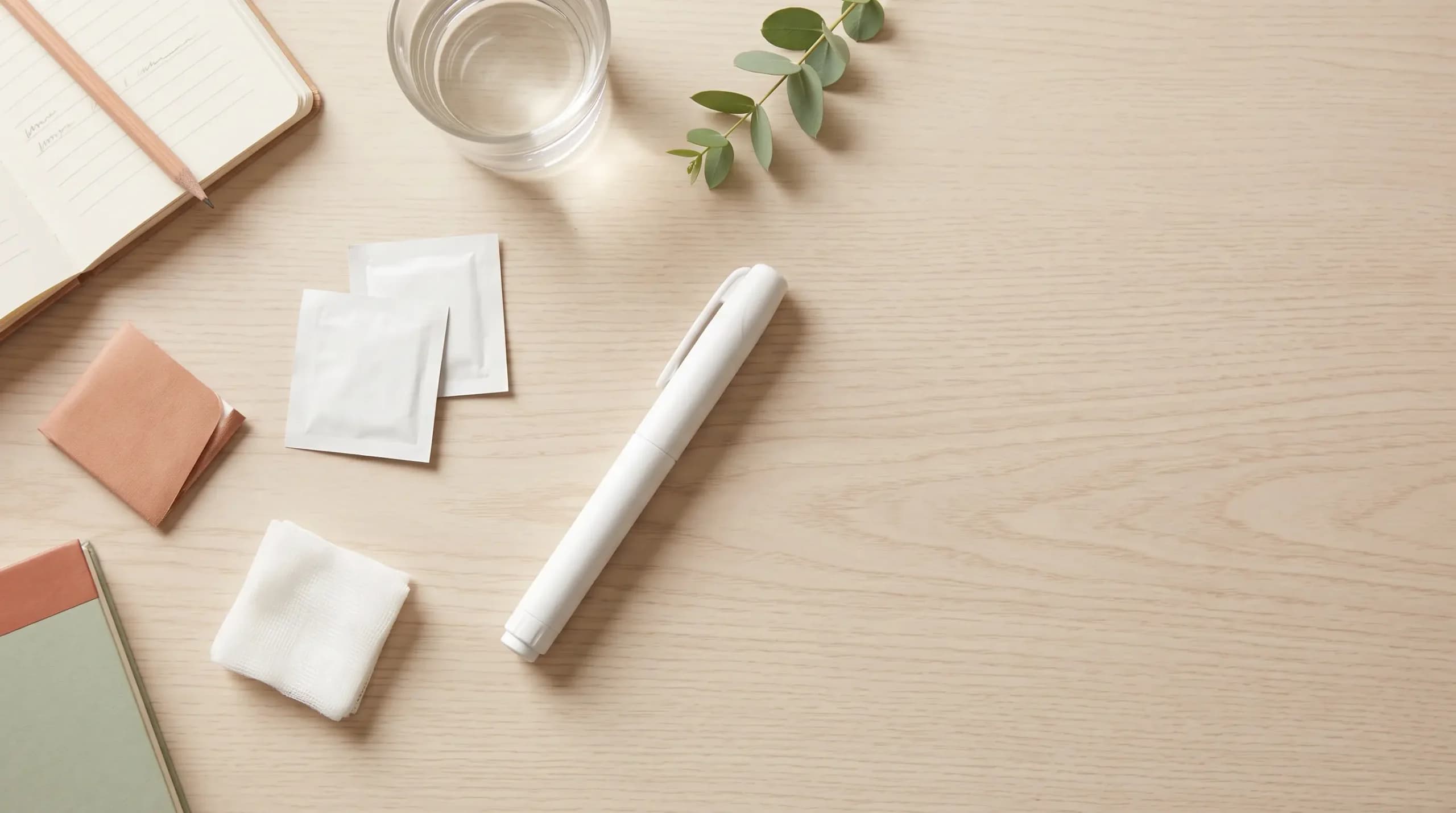
The short answer
To inject tirzepatide, you use a subcutaneous injection once a week into the abdomen, thigh or upper arm. Use the same day each week. Time of day is flexible, with or without food. Rotate to a different site with each dose. Exact handling differs between pre-filled pens and vials, and both are covered below.
⚠️ Read This First
This guide supplements the instructions supplied with your medication. It does not replace them.
Follow the Instructions for Use that came with your product and the guidance your prescriber gave you. Device handling differs between manufacturers and between pens and vials. Where your own documentation differs from anything here, your documentation is correct.
This article is written for people who have already been prescribed tirzepatide and trained on injection technique. If you have not been trained, ask your prescriber or pharmacist before your first dose.
Key takeaways
- Three approved sites: abdomen, front of thigh, back of upper arm. Rotate with every dose.
- Once weekly, any time of day, with or without food, per FDA prescribing information.
- Inspect before injecting: it should be clear and colorless to slightly yellow.
- Let it reach room temperature for 20 to 30 minutes. Cold medication stings more.
- Never reuse a needle, and dispose of all sharps in an approved container.
Before You Inject Tirzepatide: What to Check
Running a short check before each tirzepatide injection prevents most of the problems that waste a dose. It takes under a minute.
1. Confirm the right product and the right dose. Read the label rather than recognising the box. If your dose recently changed, or your pharmacy switched product, check that what is in your hand matches your current prescription.
2. Check the expiration date. On the pen or vial itself, not only the carton.
3. Check storage status. Has it been refrigerated correctly? Has it been out longer than its room-temperature window? Has it been anywhere near freezing? If any answer is uncertain, your pharmacy before injecting.
4. Inspect the liquid. According to the FDA prescribing information for Zepbound®, tirzepatide should appear clear and colorless to slightly yellow. Do not use it if you see particles or discoloration.
5. Let it come to room temperature. Take it out 20 to 30 minutes before injecting. Cold medication stings noticeably more. Do not warm it with hot water, a microwave or direct heat.
6. Gather your supplies before you start. Pen or vial, syringe and needle if applicable, alcohol swab, gauze, and an approved sharps container within reach.
7. Wash your hands. Soap and water, then clean the injection site with an alcohol swab and let it air dry completely.
That last point matters more than it sounds. Injecting through wet alcohol is a common cause of stinging that people wrongly attribute to the medication.
Where Do You Inject Tirzepatide?
Tirzepatide is injected into three approved sites: the abdomen, the front of the thigh, and the back of the upper arm. All three are areas with a layer of subcutaneous fat beneath the skin.
A subcutaneous injection is one delivered into the fatty tissue layer between the skin and the muscle. That layer has a slower, steadier blood supply than muscle, which gives the predictable absorption a weekly medication depends on.
Depth is the reason the site choice matters. Inject too shallow and the medication sits in the skin, causing irritation and unreliable absorption. Inject too deep and it enters muscle, where absorption is faster and less predictable than intended.
The three sites in practice:
- Abdomen. The most commonly used site. Stay at least two inches away from your navel. Generally the easiest to reach and the most consistent absorption.
- Front of thigh. The upper outer area, roughly midway between hip and knee. Easy to self-administer while seated.
- Back of upper arm. The fleshy area at the back. Effective but awkward to reach yourself. Usually easier with help.
Areas to avoid at any site:
- Skin that is bruised, tender, red or hard.
- Scars, stretch marks and moles.
- Areas with visible lumps or thickening from previous injections.
- Broken, irritated or infected skin.
- Within two inches of the navel.
How to Rotate Injection Sites
Rotating injection sites means using a different spot each week rather than returning to the same place. The instruction appears on every label. The reason behind it almost never does, which is why people ignore it.
Repeatedly injecting into the same patch of tissue can cause lipohypertrophy, a build-up of firm fatty tissue under the skin. It typically feels like a rubbery lump and may look slightly raised.
Lipohypertrophy matters for one practical reason: absorption through that altered tissue can become unreliable. This is well documented in insulin therapy, where injecting into affected sites is a recognised cause of erratic drug levels.
Applied to a weekly medication, that means a dose injected into a repeatedly used site may not be absorbed as intended. You would have no way of knowing. The pen empties normally and nothing looks wrong.
A rotation system you will actually remember:
Divide each site into quadrants and work around them in a fixed order. For example: upper-left abdomen, upper-right abdomen, lower-left abdomen, lower-right abdomen, then move to the thighs and arms before returning.
Within each quadrant, move about an inch from your last spot. Log the site alongside the date each week. Most people who rotate reliably are writing it down.
Table 1: Injection Sites Compared
| Site | How to access it | Notes |
|---|---|---|
| Abdomen | Sit or stand, pinch loose tissue at least 2 inches from the navel | Most commonly used. Generally the most consistent absorption |
| Front of thigh | Sit with leg relaxed. Use the upper outer area | Easy to self-administer. Avoid injecting into muscle in lean thighs |
| Back of upper arm | Reach across, or ask for help | Effective but hardest to reach alone. Easiest with assistance |
How to Inject Tirzepatide With a Pen
Single-dose tirzepatide pens are pre-filled and pre-measured. There is no dose to draw up and no syringe to prepare.
- Remove the pen from the fridge and let it sit 20 to 30 minutes to reach room temperature.
- Check the label. Confirm the product, the dose and the expiration date.
- Inspect the liquid through the viewing window. It should be clear and colorless to slightly yellow.
- Wash your hands.
- Choose your site and clean it with an alcohol swab. Let it air dry.
- Pull off the base cap. Do not replace it. Do not touch the exposed needle area.
- Place the flat base firmly against your skin at the angle specified in your Instructions for Use.
- Unlock the pen by turning the lock ring, following your product’s instructions.
- Press and hold the injection button. You will usually hear a first click as the injection starts.
- Keep holding for the full duration specified in your instructions, commonly up to 10 seconds. A second click typically signals completion.
- Check the viewing window to confirm the medication has been delivered.
- Lift the pen straight off your skin.
- Dispose of the pen immediately in a sharps container. Do not recap it.
The step people rush is number 10. Lifting the pen too early means part of the dose never leaves the device. Hold until you are certain it is finished, then hold a moment longer.
How to Inject Tirzepatide From a Vial
🔴 On Measuring Your Dose
This section covers technique only. It does not tell you how much to draw up.
Your dose is set by your prescriber in milligrams. How that translates to markings on your syringe depends on the concentration of your specific vial, which varies between products and pharmacies.
Do not calculate this from anything you find online. If you are not completely certain which marking corresponds to your prescribed dose, call the pharmacy that dispensed your medication before drawing anything up.
- Remove the vial from the fridge and let it reach room temperature.
- Check the label: product, concentration, expiration date.
- Inspect the liquid. Clear and colorless to slightly yellow, with no particles.
- Wash your hands.
- Wipe the vial stopper with an alcohol swab. Let it dry.
- Attach a new needle to a new syringe. Never reuse either.
- Draw air into the syringe equal to the volume you will withdraw, if your instructions specify this step.
- Insert the needle through the stopper and inject the air into the vial.
- Invert the vial and draw the medication slowly to your prescribed marking.
- Check for air bubbles. Tap the barrel to bring them to the top, then push them out gently.
- Verify the volume again against your prescribed dose before removing the needle.
- Withdraw the needle from the vial.
- Clean your chosen site with alcohol and let it air dry.
- Pinch the skin to lift the subcutaneous layer away from muscle.
- Insert the needle at the angle specified in your instructions, usually 90 degrees.
- Depress the plunger slowly and completely.
- Wait a few seconds before withdrawing, so the medication disperses rather than leaking back.
- Release the pinch, withdraw the needle and dispose of the whole syringe in a sharps container.
Step 10 causes the most lost medication. Air bubbles displace liquid volume, so a syringe with a bubble contains less drug than the marking suggests.
Table 2: Pen vs Vial at a Glance
| Pre-filled pen | Vial and syringe | |
|---|---|---|
| What’s included | Complete single-dose device, needle built in | Vial only. Syringes and needles supplied separately |
| Dose measurement | Pre-measured, fixed | You draw it up. Depends on your vial’s concentration |
| Priming needed | No | No, but air bubbles must be cleared |
| Main advantage | Fewer steps, less room for measurement error | Often lower cost. Common with compounded products |
| What to watch for | Lifting the pen before delivery completes | Drawing the wrong volume, or trapped air bubbles |
Does Injecting Tirzepatide Hurt?
Most people find tirzepatide injections cause mild discomfort at most, and many report feeling almost nothing. The needles used for subcutaneous injection are short and very fine.
That is the honest general answer. Some injections do sting, and the reasons are usually identifiable.
What makes it hurt more:
- Injecting straight from the fridge. Cold liquid stings. This is the single most common cause.
- Injecting through wet alcohol. Let the swab dry fully.
- A tense muscle underneath. Relax the area before injecting.
- Hesitant, slow needle insertion. A smooth, deliberate motion hurts less than a tentative one.
- Repeatedly using the same spot. Another reason rotation matters.
If you are nervous about your first injection, that is extremely common. Injection anxiety is a normal response, not a character failing, and it usually fades within a few weeks once you have proved to yourself that it is manageable.
Things that genuinely help: have someone with you the first time; sit down; do not watch the needle if watching makes it worse; breathe out as you insert; and know in advance that the anticipation is almost always worse than the event.
If anxiety is severe enough to make you consider skipping doses, tell your provider. There are practical options, and this is a well-recognised issue.
What Time of Day Should You Inject Tirzepatide?
You can inject tirzepatide at any time of day, with or without food. The FDA prescribing information places no restriction on timing.
What matters is the interval, not the clock. Tirzepatide is a once-weekly medication, and consistency keeps blood levels stable.
Choosing a day. Pick one that is reliably convenient. Many people choose a day where a possible off-feeling the following day is least disruptive.
Changing your injection day. According to the FDA prescribing information for Zepbound, the day of weekly administration can be changed if necessary, as long as at least 3 days (72 hours) separate two doses.
Missed doses. The same labelling states that a missed dose should be taken as soon as possible within 4 days (96 hours).
If more than 4 days have passed, it says to skip the missed dose and take the next one on the regularly scheduled day.
Whatever the label says, contact your prescriber if you have missed a dose or want to change your schedule. Your situation may differ from the general case, particularly if your product differs from branded Zepbound. Never take two doses close together to catch up.
What Are the Most Common Tirzepatide Injection Mistakes?
Most injection problems are small, avoidable and invisible at the time. That is what makes them expensive: nothing tells you anything went wrong until results are disappointing weeks later.
Table 3: Common Mistakes and What They Cost
| Mistake | Why it matters | Do this instead |
|---|---|---|
| Injecting cold from the fridge | Significantly more painful. A common reason people dread injecting | Take it out 20-30 minutes early. Never heat it artificially |
| Not rotating sites | Risks lipohypertrophy, which can make absorption unreliable | Move to a different quadrant each week. Log it |
| Reusing needles | Dulls the needle, raises infection risk, increases tissue damage | New needle every time, no exceptions |
| Injecting too deep, into muscle | Faster, less predictable absorption than intended | Pinch the skin. Use the angle in your instructions |
| Injecting too shallow, into skin | Irritation and poor absorption | Use a site with adequate subcutaneous tissue |
| Not checking the product first | A degraded or wrong-dose product delivers an unintended result | Inspect appearance, dose, expiry and storage every time |
| Lifting the pen too early | Part of the dose stays in the device. You lose drug and never know | Hold for the full duration, then a moment longer |
| Air bubbles left in the syringe | Displaces liquid, so the marked volume contains less drug | Tap the barrel, clear the bubbles, re-verify before injecting |
| Injecting into scarred or lumpy tissue | Unpredictable absorption from altered tissue | Feel the site first. Avoid anything firm or raised |
| Loose sharps disposal | Injury risk to household members and waste handlers. Often unlawful | Use an approved sharps container. Never household trash |
These mistakes are invisible, which is the problem. A partly delivered dose looks identical to a full one. When results stall, technique is rarely the first thing anyone checks. A supervised program reviews it alongside your dose.
What Should You Do After Injecting Tirzepatide?
After injecting tirzepatide, apply light pressure to the site with clean gauze if needed. Do not rub the area, as rubbing can irritate the tissue and affect absorption.
Normal after an injection:
- A small spot of blood or a light bruise.
- Mild redness lasting a few hours.
- Slight tenderness or itching at the site.
- A small raised bump that settles within an hour or two.
Contact your provider if you notice:
- Redness, swelling or warmth that spreads or worsens after 24 hours.
- Pain that increases rather than settles.
- Pus, or fluid other than a small amount of blood.
- A firm lump that does not resolve over several days.
- Any sign of a systemic allergic reaction, including widespread rash, swelling of the face or throat, or difficulty breathing. Seek urgent care for these.
Log the dose and the site. Date, dose, site and anything unusual. It takes ten seconds and it is the only reliable way to rotate properly and to give your provider useful information later.
How Do You Dispose of Tirzepatide Needles Safely?
Used tirzepatide pens, syringes and needles must go into an FDA-cleared sharps disposal container. They should never go into household trash or recycling.
Use an approved sharps container where possible. If one is not immediately available, guidance generally suggests a heavy-duty plastic container with a tight-fitting, puncture-resistant lid, kept upright and labelled.
Never use: glass containers, thin plastic bottles, soda bottles, milk jugs or anything that can be punctured or crushed.
Do not recap needles. Recapping is a leading cause of needlestick injury.
Fill to about three quarters, then seal and dispose according to your local rules.
Disposal routes vary by jurisdiction, and this is the part people get wrong. Options commonly include pharmacy take-back programs, household hazardous waste collection sites, mail-back services, and hospital or clinic drop-off points. Requirements differ by state and country, and some places have specific legal rules.
Check your local health department or ask your pharmacist what applies where you live. Do not assume guidance written for another region applies to you.
Technique Is Worth Checking, Not Assuming
Almost nobody has their injection technique reviewed after the first time they are shown. Habits drift. Products change. Rotation slips.
None of this announces itself. A dose partly left in the pen, or absorbed unpredictably from an overused site, looks exactly like a dose that went perfectly, and it quietly changes when tirzepatide starts working.
That is why technique and storage belong in the conversation when results stall, before anyone reaches for a dose increase.
Questions about your technique are clinical questions.
 Facebook
 Email
Email